Home / Aesthetic dermatology / Laser hair reduction
Laser hair reduction
Laser hair reduction gives long-term reduction of unwanted hair on the face and body. It works best on dark hair and needs a series of sessions.
How the laser works
The laser targets the pigment in the hair root and heats it, reducing its ability to grow. Hair in the growing phase responds, so several sessions are needed.
Before and during each session
At the first visit we assess skin and hair type. In women with excess facial or body hair we check for hormonal causes like PCOS, which need treatment too.
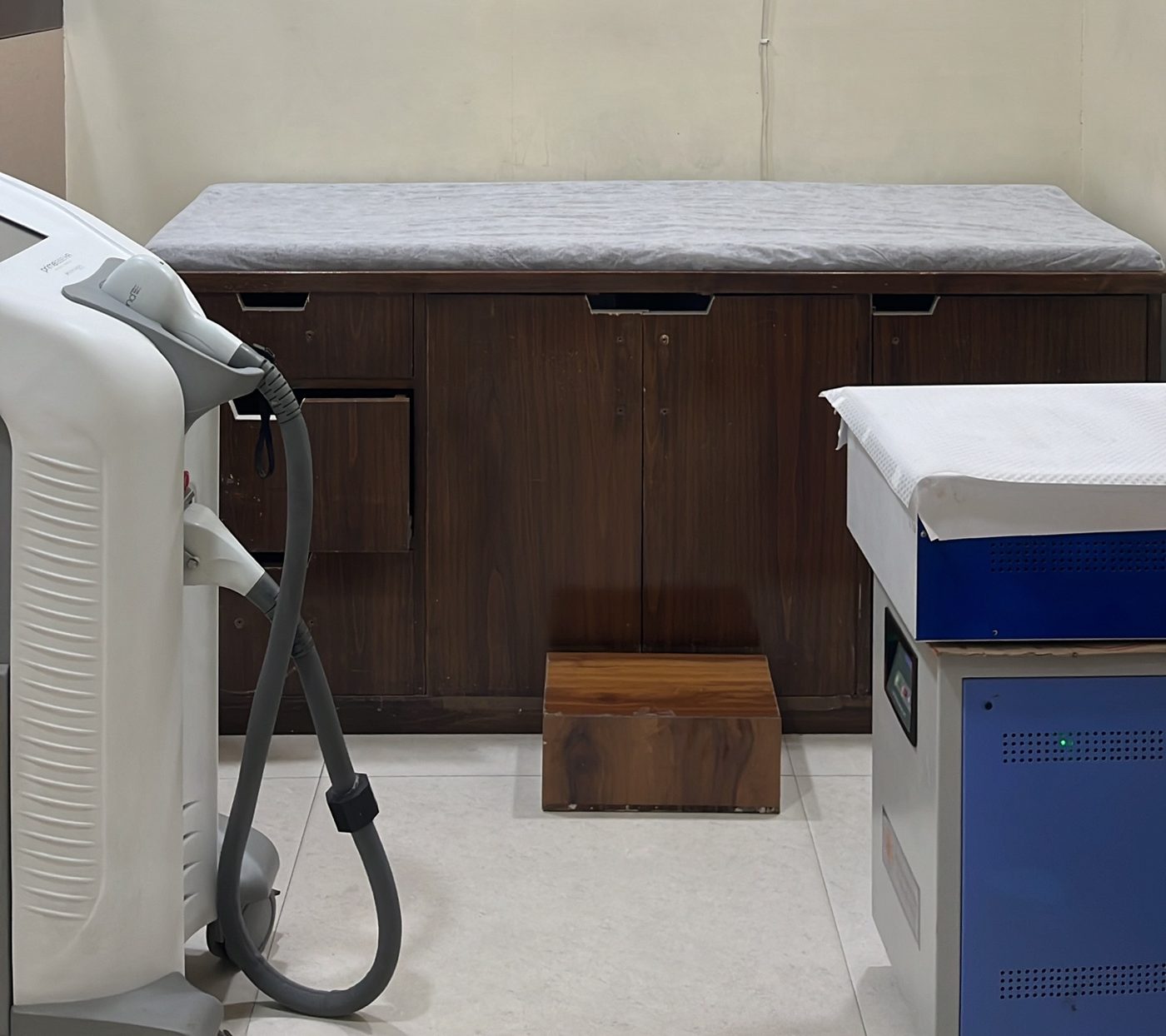
We use the Primelase triple-wavelength laser, which lets us adjust the treatment for different skin types and hair thickness.
Before every session we go through four safety questions, your previous settings and photographs, and the doctor approves the settings. Goggles, cooling and a test patch at the first session are standard.
The area is treated in a systematic grid, with no gaps or overlaps.
Sessions
| Sessions | 6 to 8 or more, 4 to 6 weeks apart |
| Reduction | Usually visible after 3 to 4 sessions |
| Maintenance | Occasional sessions afterwards |
Between sessions
Redness for a day or two is normal, and treated hairs shed between day 7 and 14. No waxing, threading or bleaching between sessions; shave 12 to 24 hours before the next one. Sunscreen every day.
Questions
Is it permanent?
It gives long-term reduction, not complete permanent removal. Some fine hair and hormonal regrowth can need maintenance.
Does it work on fine or light hair?
Less well. Dark, coarse hair responds best.
Is it safe for Indian skin?
Yes, with the right laser and settings for your skin type.
Where
Laser hair reduction is seen at both our clinics in Noida: C-50, opposite Community Centre, Sector 15 and D-224, Sector 55. Monday to Saturday, 10 am to 7 pm.
References
- Griffiths C, Barker J, Bleiker T, et al., eds. Rook's Textbook of Dermatology. 10th ed. Wiley-Blackwell; 2024.
- Sacchidanand S, et al., eds. IADVL Textbook of Dermatology. 4th ed. Bhalani Publishing; 2015.